I Joined a Hackathon to Meet Guyana’s Developers. Somehow, We Came Second.
I signed up for Innovation Challenge 2026 to meet Guyanese developers. Three days, almost no sleep, one prototype, and a second-place finish later, I got exactly what I came for.
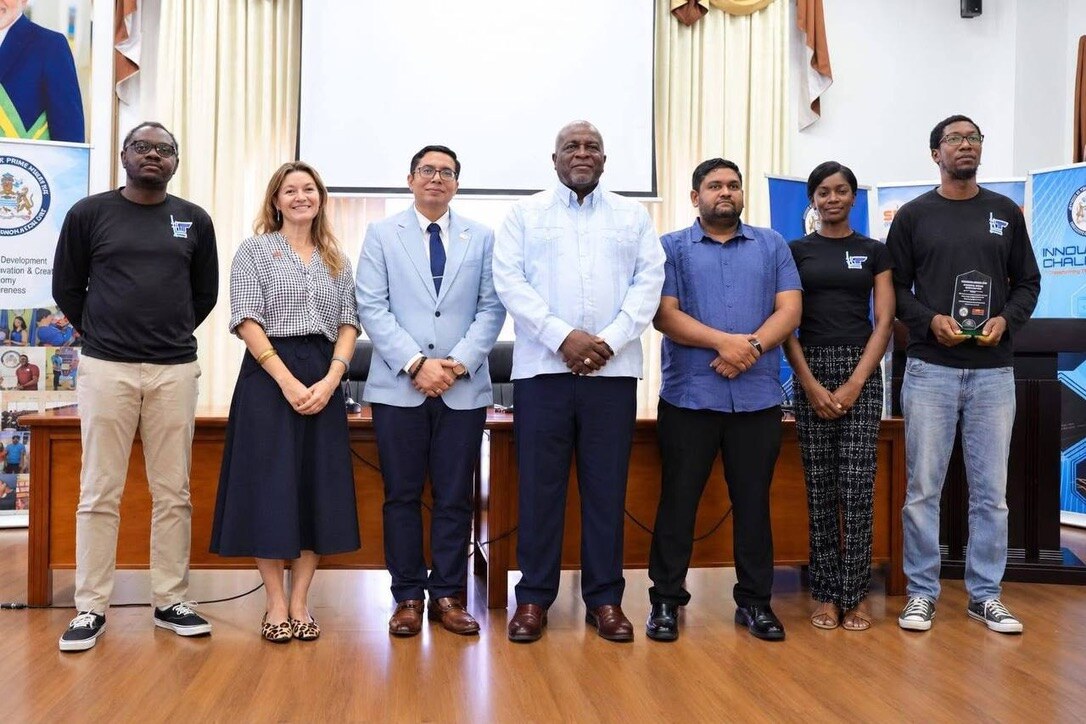
I Wasn’t Thinking About the Prize
I was turning into the Arthur Chung Conference Centre with a monitor sitting in the back seat of my car. I had already decided against bringing the whole desktop. Laptops would have to do. So I grabbed the monitor, started heading up to the conference centre, and I wasn’t thinking about prize money.
I didn’t even know what the prize money was when I signed up.
The Innovation Challenge is run by the Office of the Prime Minister through its Industry and Innovation Unit, in collaboration with SBM Offshore Guyana.
I signed up Lugetech for the Innovation Challenge 2026 for one main reason:
I wanted to see where all the developers were.
That might sound strange, but if you’re a developer in Guyana, you probably understand what I mean. I know we have developers here. Obviously. I just don’t get to see many of them in one place. Most of us are somewhere behind a screen, working at a company, freelancing, building our own thing, studying, or just quietly getting very good at something.
I wanted to meet some of these people. My people, basically. That was genuinely my motivation.
Then the Doors Opened
I walked up the stairs, went through the doors and there they were.
Developers. Everywhere.
People talking, laptops open, monitors on tables, teams getting themselves organised. And it was pretty much exactly what I had imagined. I know this probably sounds overly dramatic for walking into a room full of programmers, but I was excited as hell.
We found our table and started setting up. For this challenge, Lugetech was a three-person team: me, Sunaika Adolphus and Kiewart Gulliver. Teams could have been larger, but those were the three of us available for the weekend.
Monitor down. Chargers plugged in. Laptops open.
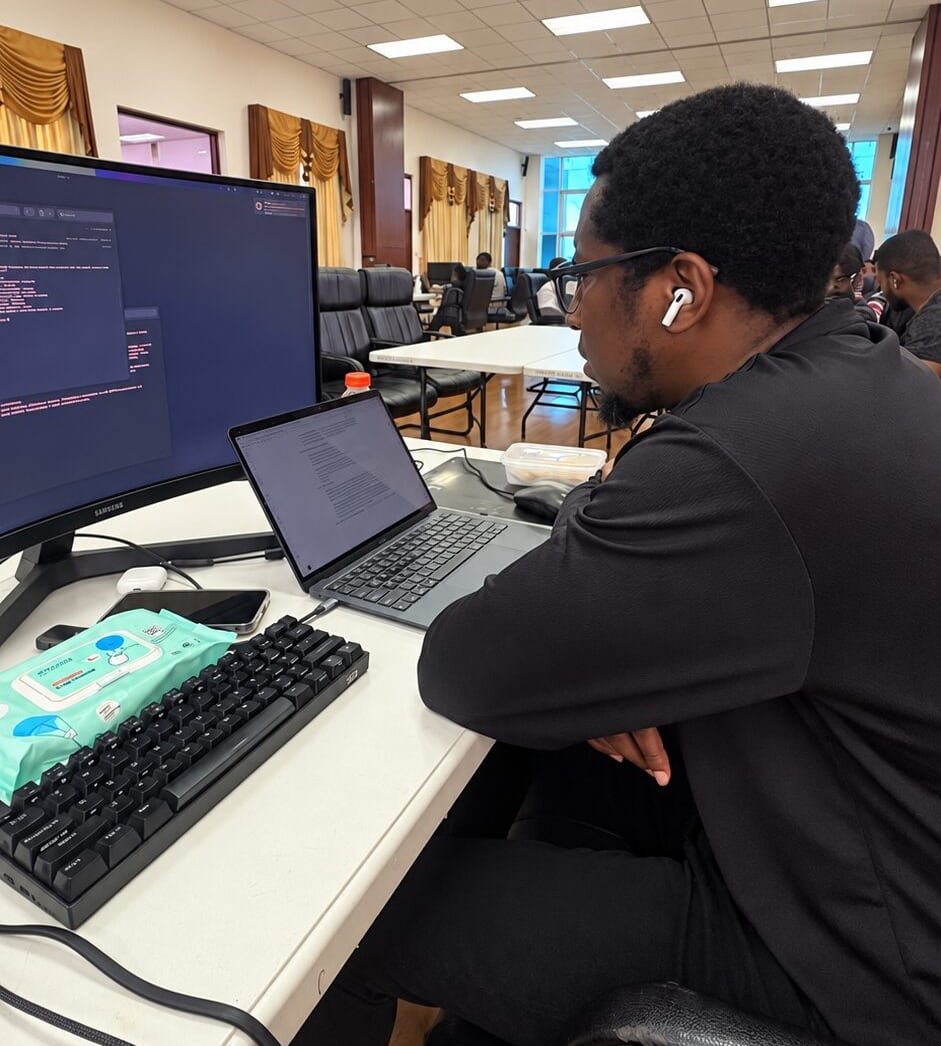
I sat there for a minute looking around and thinking:
Wow. I’m actually at a hackathon, surrounded by other developers from Guyana.
Mission partially accomplished already.
Then, of course, they gave us the actual problem.
Okay, Now We Have to Build Something
How can technology help Guyanese people acquire the skills needed to participate in the energy sector?
Immediately, ideas started flying. One thing I knew: I did not want to make another job board.
We have job websites. Making another website where employers post jobs and people upload CVs wasn’t interesting enough to me, and more importantly, it didn’t really solve the deeper problem. The interesting part of the challenge was the gap between the skills Guyanese people already have and the skills the energy sector needs.
Sunaika and I started pulling the problem apart from different angles. Her background gave her a very practical view of workforce issues: what employers actually need, what applicants might be missing, and how training and institutions fit into all of this.
We bounced ideas back and forth. Before long, we had something. We called it Skills Gap.
What We Built
The basic idea behind Skills Gap was simple: you tell the system what you can do, and it helps you figure out where you could fit into the energy sector. And I don’t mean you need a beautifully written CV full of industry terminology. You could describe your actual life experience in normal language.
For example:
“I dive for gold and diamonds in the interior.”
That sentence might not sound like something you would put into an oil and gas job search. But there are skills inside that sentence. You work in dangerous environments. You understand equipment. You operate under pressure, literally in this case. You may have experience with safety procedures, remote work, mechanical systems, communication and plenty of other transferable skills.
The platform’s job was to understand that.
From there, it could identify energy-sector roles that matched your existing abilities and tell you something like:
You’re a 70% match for this role.
Then, more importantly:
Here’s the missing 30%.
Maybe you need a particular safety certification. Maybe you need a technical course. Maybe you need a degree. Maybe you only need one relatively small piece of training before you become a realistic candidate.
Skills Gap would show you what you were missing and where in Guyana you could get it. That was the part I liked.
Not just “You don’t qualify.”
Instead:
“You’re actually pretty close. Here’s the path from where you are now to where you need to be.”
We designed the system so energy companies and training institutions could maintain their own information rather than us building some giant web-scraping machine and hoping everything stayed accurate. Companies could maintain real roles and requirements. Training institutions could maintain programmes, costs, dates and prerequisites. The matching happened between actual industry demand and actual training opportunities.
I can go much deeper into the app, but that’s another post. This one is about the experience.
Sleep Became Optional
There was one slight issue with our team. At the time, I was the only person actually coding the application.
I knew that going in. I accepted my fate. And I paid for it.
At one point, I had been awake for something like 36 or 37 hours straight.
Would recommend? No. Will probably somehow do it again? Yes.
But there was something strangely enjoyable about it. It was late. Everyone was still working. You could walk around and see teams buried in whatever problem they were trying to solve. There was food, places to sit, good Wi-Fi and computers everywhere. For a developer, it wasn’t exactly the worst place to be trapped for a weekend.
And because we were all there overnight, you got little opportunities to talk to people that you normally wouldn’t meet. It was still a competition, obviously. Not everybody was walking around trying to become best friends with the team beside them.
But quite a few people came over, introduced themselves, asked how the project was coming along, told me about themselves, and just talked tech. That was exactly what I had come for.
Then I Met Eldon Marks
One of the biggest highlights of the entire weekend for me was finally meeting Eldon Marks. If you know Guyana’s tech scene, you probably already know the name. In my personal Guyanese developer tier list, the man is basically god-tier. Excuse me while I gloat for a minute.
I’ve watched what Eldon has done for years: software, businesses, AI, mentoring, building communities, creating opportunities for other developers. A lot of the things I want to be able to do at a higher level, I’ve watched him do. And lately he has been heavily involved in AI, which happens to be the rabbit hole I’m currently very deep inside too.
So yes, I met the guy.
We ended up talking for around ten minutes about different things: development, AI and vibe coding, projects, the hackathon. At the end he wished us luck and mentioned that maybe we could link up on something in the future.
Sir, if you ever read this:
I’m ready.
Call me.
Then Somebody Humbled Me With C
One of my favourite parts of the final presentations was getting to watch what everybody else had built. Remember, seeing what Guyanese developers were working on was half the reason I came in the first place. And one presentation in particular had me staring at the screen.
There was a guy, I think his name was Josh, who had built this underwater robotic/submarine-type system. He had modelled the thing in 3D and was controlling it with something like 60 lines of C.
I’m looking at this thing thinking:
How the hell?
I have React components with 300, 400, 500 lines of code that don’t do anything remotely as cool as this.
And while he was presenting, you could see how much he loved what he had built. You could hear it in his voice. See it on his face. I love that stuff. I don’t think people realise how much I enjoy seeing somebody who is genuinely good at something get excited about their thing.
After the competition I called out to him from a balcony and we spoke briefly there, then he came upstairs and sat with us for a while. Unfortunately, at this point my brain was operating on emergency backup power. I was barely awake, so I probably wasn’t giving him the full conversation I would have liked.
But I got to meet him. Hopefully he remembers me.
There were a lot of people like that in the room. Really smart people quietly building really cool things in Guyana.
Oh Yeah. We Came Second.
Eventually, presentation day came. We presented Skills Gap. Then we sat down and watched everybody else.
And Lugetech placed second in the Senior Category.
Second.
I’m not going to pretend that wasn’t nice. It was. Very nice.
But the funny thing is, when I think about that weekend, placing second still isn’t the first thing that comes to mind.
I remember walking through those doors. I remember seeing all the laptops. I remember talking to developers at stupid hours of the night. I remember meeting Eldon. I remember looking at an underwater robot running on a tiny amount of C code and questioning some of my life choices. I remember building something under pressure with Sunaika and Kiewart.
The award was a bonus. A very good bonus. But it wasn’t the reason I went.
I’ll Be Back
If you’re a developer in Guyana and the Innovation Challenge comes around again, I think you should enter. Even if you don’t think you’ll win. Especially if you’ve never done something like this before.
Maybe you come first. Maybe you come second. Maybe you don’t place at all.
You still spend three days around people building things. You get to see how other developers think. You see ideas you never would have come up with yourself. You work under ridiculous time constraints. You find holes in your own skills very quickly.
You grow. I definitely did.
And next year? I plan to show up at least 200% better than I did this year. Hopefully with another developer or two so I can experience this strange thing people keep telling me about called sleep.
Innovation Challenge 2027, I’ll be there. Let’s see what happens.
Written from Guyana, where I went looking for developers and somehow came home with second place.
About The Author
Ken Taylor
Self-taught Guyanese software engineer and entrepreneur from Georgetown, Guyana building tech solutions for the Caribbean.
# Related Posts
Local LLMs on Intel Arc: Why Running AI at Home Just Makes Sense
A cheap gaming GPU, some clever model architecture, and a coding agent that runs on local AI. Here's what I've learned hosting LLMs on an Intel Arc B580.
From Internet Cafes to VPS: How I Became a Programmer in Guyana
A journey from bash scripts on borrowed computers to building Luge Tech and self-hosting everything. The story of learning to code in Guyana's internet cafe era.